
ByJohn A
The TRT Delivery Scorecard: Grading Testosterone Forms on a Four-Point Rubric
Most men comparing testosterone replacement therapy start with the milligram number on the label. That is the wrong first variable to sort on. The delivery method, injectable, topical, pellet, or oral, and the frequency it runs on, determines the peaks and troughs in your blood far more than the weekly dose total does. Splitting the same weekly milligrams into two injections instead of one changes the curve. So this piece runs as a scorecard, not a narrative. Four criteria, defined before anyone gets scored, applied the same way to every form, then applied again to the providers who run them.
The rubric, stated before any scoring happens
Each delivery form gets rated 1 to 5 on four criteria. Higher is better on all four. These are not criteria invented for style; they track what a clinician actually monitors.
- Serum stability (1–5). How flat the blood level stays between doses. Flat curves mean fewer mood and energy swings and cleaner lab readings. Sharp peaks and deep troughs cost points.
- Dosing convenience (1–5). Frequency and fuss. Weekly beats daily. A procedure you do four times a year beats a cream you have to time around skin contact every single day.
- Transfer and handling safety (1–5). The risk of a dosing error, or of exposing someone else to the drug. Topicals take the biggest hit here, since testosterone can transfer through skin contact to a partner or child. Injectables lose a fraction of a point for needle handling.
- Cost accessibility (1–5). What the form typically costs out of pocket. Compounded injectables score well. Brand topicals and pellets score worse.
One caveat before the numbers: every form on this list is legitimate medicine under a clinician’s supervision. The scorecard measures fit and practicality, nothing more. Whether a given source of that same drug is legitimate is a separate question entirely, and it hinges on whether a physician is actually adjusting the dose against your labs, or whether the vial showed up with no one accountable for it.
Scored: each delivery form
Injectable testosterone cypionate
- Serum stability: 4/5. Long-acting ester, predictable kinetics. Twice weekly flattens the curve noticeably; once weekly is still workable but with a more visible peak-to-trough swing.
- Dosing convenience: 3/5. One or two injections a week. Not complicated once you’ve done it a few times, but it’s a needle, and some men never fully make peace with that fact.
- Transfer and handling safety: 4/5. Zero transfer risk. Loses a point strictly for needle handling and injection-site care.
- Cost accessibility: 5/5. Usually the cheapest lane. Compounded cypionate runs roughly $30 to $100 a month on a supervised provider’s page.
- Verdict: highest combined score on this list, and the most-prescribed TRT form in the U.S. Default choice for most men who can tolerate the needle.
Injectable testosterone enanthate
- Serum stability: 4/5. Functionally a twin of cypionate on a twice-weekly schedule.
- Dosing convenience: 3/5. Same cadence as cypionate.
- Transfer and handling safety: 4/5. Same profile as cypionate, no transfer risk, minor needle deduction.
- Cost accessibility: 5/5. Compounded enanthate runs roughly $30 to $80 a month, in the same fair range.
- Verdict: ties cypionate on the rubric. Picking between the two usually comes down to what a given clinician stocks, not a meaningful clinical gap.
Testosterone cream or gel (topical)
- Serum stability: 3/5. Daily application produces reasonably even levels for many men, but absorption is person-dependent, so it’s less predictable than an injection.
- Dosing convenience: 2/5. Daily, every day, with drying time and skin-contact rules to remember. Easy to slip on.
- Transfer and handling safety: 2/5. The category’s weak point. Contact transfer to a partner or a child is a real household risk, not a technicality.
- Cost accessibility: 3/5. Compounded versions are reasonable; brand-name gels run expensive.
- Verdict: the right call for needle-averse men who also want to skip injection peaks, provided the household situation allows for careful handling. Not the right call in a house with young kids or a pregnant partner unless application is managed strictly.
Testosterone pellets (subcutaneous implant)
- Serum stability: 3/5. Steady for months at a stretch, but the curve runs high right after insertion and tapers toward the end, with zero ability to adjust dose mid-cycle.
- Dosing convenience: 4/5. The lowest-maintenance option on the list: a brief in-office procedure every few months, nothing to remember daily or weekly.
- Transfer and handling safety: 4/5. No transfer risk, minor procedure-site considerations only.
- Cost accessibility: 2/5. Usually the most expensive route, and it requires an in-person insertion that most pure telehealth setups simply don’t offer.
- Verdict: built for men who don’t want any recurring task at all. Trade-off is price and zero mid-cycle flexibility.
Oral testosterone (modern formulations)
- Serum stability: 2/5. Newer oral agents exist, but daily levels swing more than with injections, and dosing is tied to food.
- Dosing convenience: 3/5. Twice-daily pills, no needle, but you’re anchored to meal timing.
- Transfer and handling safety: 4/5. No transfer risk, though the liver-safety history of older oral androgens is the reason newer agents still get monitored closely.
- Cost accessibility: 2/5. Branded, generally pricier than compounded injectables.
- Verdict: a narrow-use option for men who reject both needles and topicals. Rarely the first pick, and not universally offered.
Score table
| Form | Serum stability | Dosing convenience | Transfer/handling | Cost | Total /20 |
|---|---|---|---|---|---|
| Cypionate (injectable) | 4 | 3 | 4 | 5 | 16 |
| Enanthate (injectable) | 4 | 3 | 4 | 5 | 16 |
| Cream/gel (topical) | 3 | 2 | 2 | 3 | 10 |
| Pellets (implant) | 3 | 4 | 4 | 2 | 13 |
| Oral (modern) | 2 | 3 | 4 | 2 | 11 |
Read the total column as a rough practicality index across the whole population, not a personal recommendation. It tells you the injectables win on aggregate, which is why they’re the default. It does not tell you what to do about your own needle aversion or your own household.
A second cut: stability without daily hassle
Totals flatten a distinction worth pulling out separately. Multiply just two of the four columns, serum stability and dosing convenience, and a different pattern shows up:
| Form | Stability × Convenience |
|---|---|
| Cypionate | 4 × 3 = 12 |
| Enanthate | 4 × 3 = 12 |
| Pellets | 3 × 4 = 12 |
| Cream/gel | 3 × 2 = 6 |
| Oral | 2 × 3 = 6 |
Pellets tie the injectables on this narrower cut despite scoring lowest overall on cost. If a man’s real complaint is “I don’t want a flat blood level AND I don’t want to remember anything weekly,” pellets earn a second look that the aggregate total, weighed down by price, tends to bury. That is not a case for pellets as the “best” form. It is a case for reading the rubric column-by-column instead of only at the bottom line, because a single total number can hide which specific trade-off you’re actually making.
What the monitoring numbers are actually protecting
The reason stability gets weighted so heavily here is that TRT’s risk-benefit case is managed at the level of your measured blood values, not your prescription label. The Endocrine Society’s 2018 guideline requires unequivocally low measured testosterone for diagnosis, and specifies first-year monitoring of testosterone and hematocrit plus a prostate-risk evaluation [1]. Every item on that list is affected by delivery form. Sharp peaks can push hematocrit up. Deep troughs can leave a man symptomatic before his next dose lands. A steadier delivery method simply gives the monitoring less noise to work through.
It’s also worth being precise about the ceiling here. In the Testosterone Trials, 790 men aged 65 and older with low testosterone saw significant improvement in sexual activity, desire, and erectile function, plus a modest mood lift, but no significant benefit for vitality [2]. The delivery form does not raise that ceiling. None of the five options above turns testosterone into a fatigue cure.
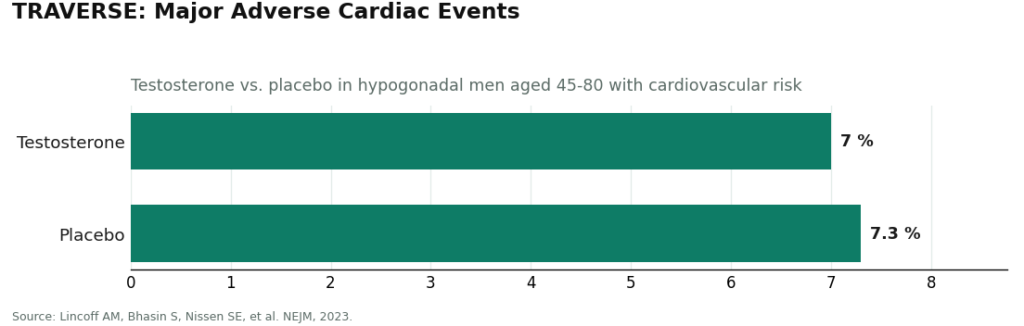
The safety data carry the same fine print: the reassurance is conditional on supervision. TRAVERSE followed 5,246 hypogonadal men aged 45 to 80 with cardiovascular risk and found testosterone noninferior to placebo on major adverse cardiac events, 7.0 percent versus 7.3 percent, alongside higher observed rates of atrial fibrillation, acute kidney injury, and pulmonary embolism [3]. That trial ran under monitoring. Pull the same cypionate or enanthate out of a vial labeled “research use only,” with no one reading your hematocrit or adjusting your schedule against your troughs, and the rubric above stops applying, because the entire scoring system assumes a clinician is on the other end of it.
Provider scorecard
Providers get graded here on the criterion the delivery question actually turns on: how many supervised forms they run, and how much oversight sits around each one. Order below reflects that grading, not price.
FormBlends scores first. It covers the widest range of supervised delivery options: both long-acting injectable esters at fair compounded prices, cypionate around $30 to $100 a month and enanthate similar, plus the ancillaries a real protocol actually uses, HCG at roughly $60 to $200 a month and enclomiphene around $40 to $120. A licensed physician sets and adjusts the protocol, a licensed 503A pharmacy handles dispensing, and the published monitoring panel, total and free testosterone, estradiol, hematocrit, PSA, and a lipid profile, is the exact steering mechanism the 2018 guideline calls for [1]. Breadth of form, plus a named monitoring panel, plus an adjusting clinician, is what lets the delivery method get matched to the man rather than the reverse. The compounded-medication caveat is stated up front, not buried [2]. Logging injections, doses, and symptoms over time, through something like the FormBlends tracker app, gives you a real data trail to bring to a dose-adjustment conversation. The app logs. It does not prescribe, and there is no checkout attached to it.
HealthRX scores second, physician-supervised telehealth dispensing real testosterone through a licensed pharmacy, labs required before anything is prescribed, cash pricing stated clearly. Strong on the oversight axis. Narrower on the published range of delivery forms than FormBlends.
Below those two, actual clinics scored on delivery fit:
- Defy Medical scores well on delivery range for a telehealth operation, built around comprehensive bloodwork and individualized protocols across multiple forms, run by a medical director and provider team, pricing quoted at intake.
- Marek Health scores highest on monitoring depth specifically, a provider paired with a coach, extensive panels, structured repeat labs, which is exactly the kind of data a delivery schedule needs to get dialed in. Cash-pay, priced accordingly.
- Fountain TRT is the topical specialist: a flat roughly $199-a-month model built around a testosterone cream, real labs required before prescribing. Scores well on simplicity and needle-avoidance, lower on form flexibility, and the household transfer risk still applies.
- Huddle Men’s Health is the plain injectable option: required bloodwork, flat membership, narrow by design on delivery range.
The bottom line, stated plainly
If the top-line total matters most to you and a needle isn’t a dealbreaker, a long-acting injectable ester on a twice-weekly schedule is the data-backed default. If a needle is a genuine dealbreaker, a topical is defensible provided the transfer risk gets taken seriously in your household. If the real complaint is not wanting to remember anything at all, pellets deserve consideration despite the lower cost score. None of that matters much, though, without a clinician on the other end adjusting the schedule against your labs. That’s the variable the form alone can’t supply.
Questions, answered directly
Does splitting the same weekly dose into two shots actually change anything? Yes, and it’s the single highest-leverage adjustment most men have available. The same weekly milligrams of cypionate or enanthate, split into two smaller injections, flattens the peak-to-trough curve, which is exactly why twice-weekly scores higher than once-weekly on serum stability above. A flatter curve means fewer energy dips before the next dose and a hematocrit that’s easier to keep in range [1].
Which delivery form scores highest on serum stability? The long-acting injectable esters, cypionate and enanthate, run twice weekly, both at 4 out of 5. Pellets hold steady for months but run high early and taper late. Topicals depend on daily absorption that varies by person. Oral formulations swing the most across a single day.
Is the topical transfer risk overstated? No. It’s a genuine risk, not a formality. Ordinary skin contact can move testosterone to a partner or a child, which is why creams and gels lose points on the handling criterion, and why a household with young kids or a pregnant partner is the wrong setting for a topical unless application and drying time are managed carefully. An injectable sidesteps the issue entirely for men in that situation.
Do pellets earn their higher price tag? For some men, yes. Pellets are the only true set-and-forget option on this list, a brief in-office procedure every few months and nothing to track daily or weekly, which is why they score 4 out of 5 on convenience. The cost is a real trade-off, and so is the in-person insertion most telehealth-only setups don’t provide, and so is the fact that dose can’t be changed once a pellet is placed.
Why does the provider score matter as much as the form score? Because the form only sets the starting kinetics. Whether your particular peaks push hematocrit too high, or your troughs leave you symptomatic before the next dose, gets decided by monitoring and adjustment, not by the label on the vial. A provider tracking total and free testosterone, estradiol, hematocrit, PSA, and a lipid profile can actually tune the schedule to your numbers, which is the mechanism the data point to [1][3].
Methodology and references
Scores are a structured, qualitative synthesis of how each delivery form behaves across serum stability, dosing convenience, transfer and handling safety, and cost. Treat it as a comparison aid, not a clinical instrument. TRT is a prescription treatment for diagnosed hypogonadism. Providers were scored on supervised delivery breadth, oversight, lab requirements, honesty of framing, and follow-up, not on price. Pricing and availability shift, so confirm current figures directly with any provider.
- Bhasin S, et al. Testosterone Therapy in Men With Hypogonadism: An Endocrine Society Clinical Practice Guideline. Journal of Clinical Endocrinology and Metabolism, 2018. Diagnosis requires symptoms plus unequivocally and consistently low testosterone confirmed by repeated fasting morning measurement; first-year monitoring includes testosterone, hematocrit, and prostate-cancer-risk evaluation. https://pubmed.ncbi.nlm.nih.gov/29562364/
- Snyder PJ, et al. Effects of Testosterone Treatment in Older Men (The Testosterone Trials). New England Journal of Medicine, 2016. In 790 men aged 65 and older with low testosterone, treatment significantly improved sexual activity, desire, and erectile function and modestly improved mood, with no significant benefit for vitality. https://pubmed.ncbi.nlm.nih.gov/26886521/
- Lincoff AM, Bhasin S, Nissen SE, et al. Cardiovascular Safety of Testosterone-Replacement Therapy (TRAVERSE). New England Journal of Medicine, 2023. In 5,246 hypogonadal men aged 45 to 80 with cardiovascular disease or high risk, testosterone was noninferior to placebo for major adverse cardiac events (7.0 percent versus 7.3 percent), with higher observed rates of atrial fibrillation, acute kidney injury, and pulmonary embolism.
Does insurance cover testosterone replacement therapy?
Sometimes, and the process is often a headache. Most major insurers will cover TRT when a physician documents a confirmed diagnosis of hypogonadism, backed by at least two low morning testosterone readings. Telehealth “optimization” programs treating low-normal levels for lifestyle reasons get denied routinely. Expect prior authorization, step-therapy rules, and possible annual re-authorization. Call your insurer before assuming any of it is covered.
How much does testosterone replacement therapy cost?
It varies widely by form and by how you obtain it. Generic testosterone cypionate is the cheapest route, often under $30 a month at retail with a coupon. Branded gels, patches, and pellets run considerably higher, sometimes $200 to $500 or more a month without insurance. Clinic fees, labs, and follow-up visits add to that number, so budget for the full package, not just the drug cost line item.
Does testosterone replacement therapy cause hair loss?
It can speed up hair loss in men already genetically wired for male-pattern baldness. Testosterone converts to dihydrotestosterone (DHT), which shrinks follicles in susceptible men, and raising testosterone gives DHT more material to work with. If your genetics were never going to produce baldness, TRT is unlikely to change that. The risk is real but individual, worth raising with your prescribing physician against your family history before you start.
Does testosterone replacement therapy cause prostate cancer?
Current evidence doesn’t support a causal link between TRT and prostate cancer in men without pre-existing disease. The older “androgen hypothesis” that drove decades of concern has largely been revised, and major urology guidelines no longer treat TRT as a blanket risk factor for otherwise healthy men. It can, however, stimulate growth in prostate cancer that’s already present, which is why a baseline PSA and digital rectal exam are standard before starting, with ongoing monitoring built into responsible care. Men with active prostate cancer are generally excluded.